SCHD ETF in Europe: can you buy it, and what comes close?
By Thanos Karantonis · Economist
Can European investors buy SCHD? Check the retail disclosure rules and compare three UCITS funds by index, income policy, costs and exposure.
Most EU retail investors should expect to find UCITS alternatives more readily than SCHD itself. If what you want is SCHD’s blend of US dividends and company quality, start by comparing the Fidelity fund’s index rules. If you want global diversification or a longer dividend-growth screen, the other funds in our table solve different problems.
Which UCITS alternatives should you compare?
| If you want… | Fund to investigate | What changes |
|---|---|---|
| US dividend income plus a quality screen | Fidelity US Quality Income UCITS ETF Income, IE00BYXVGX24 | Its own Fidelity US Quality Income Index, distributing share class, 0.25% ongoing charges in the issuer’s factsheet. |
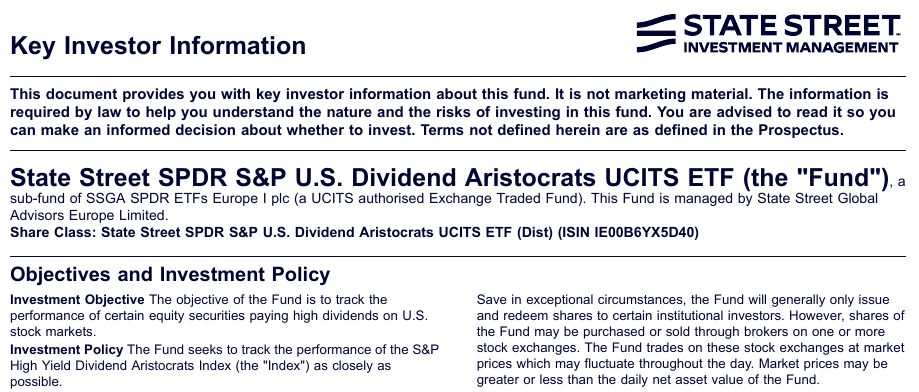
| A long history of rising US dividends | State Street SPDR S&P U.S. Dividend Aristocrats UCITS ETF (Dist), IE00B6YX5D40 | The S&P High Yield Dividend Aristocrats Index uses a 20-year dividend-increase requirement. Its issuer document lists 0.35% ongoing charges. |
| Income with geographic diversification | Vanguard FTSE All-World High Dividend Yield UCITS ETF (Dist), IE00B8GKDB10 | A global high-dividend mandate including emerging markets, with 0.29% OCF shown by Vanguard. This changes the country exposure as well as the selection rules. |
Sources: Fidelity factsheet, State Street investor information, State Street index explanation and Vanguard fund page. Each tracks a different index. Broker availability, platform fees, exchange spreads, currency conversion and taxes sit outside these charges.
Fidelity’s issuer factsheet, page 1, Fund facts identifies IE00BYXVGX24, its index and ongoing charges. The index line is the clue that this isn’t SCHD in a different wrapper. Factsheet dated 31 October 2026; document text checked 16 November 2026.
Stress test: Test the choice against a company that pays a growing dividend but carries a lot of debt. A dividend-growth screen can favour it if it meets the other rules. A quality screen that looks at cash flow relative to debt asks an additional question. Read the rulebook before assuming similar distributions imply similar holdings.
What are you trying to reproduce?
Schwab’s product page gives a 0.060% expense ratio and names the Dow Jones U.S. Dividend 100 Index. The index methodology starts with a history of dividend payments and looks at cash flow relative to debt, return on equity, dividend yield and five-year dividend growth. That is a materially different screen from picking the stocks with the highest yield today. It is also different from requiring the dividend to increase every year.
This matters more than it sounds. A company whose share price fell from €100 to €80 with a €4 annual payment would show a 5% trailing yield instead of 4%. Nothing in that calculation tells you whether the next €4 will arrive. Use the index rulebook to understand what enters the portfolio and published fund performance to judge past results. Comparing two yield numbers from different dates or methodologies won’t tell you which portfolio is doing the job you want.
A practical check before switching funds
Start with the ISIN, open the local disclosure document and read the objective and distribution policy. Then look at the market and currency on the order screen. For example, Fidelity lists the same income share class as FUSD in USD and FUSI in GBP on the London Stock Exchange. A sterling order may avoid a separate currency conversion on the ticket. It doesn’t turn US holdings into a pound-hedged portfolio. Compare annual cash distributions and total return separately. If the main attraction was a cash budget, use a conservative hypothetical payout and plan for variation rather than assuming quarterly amounts will be identical.
For the EU, PRIIPs Regulation, Articles 5 and 13 explain preparation and provision of the retail KID. SCHD is US-listed, and the Schwab documents checked for this guide did not establish an EU retail KID for it; the US prospectus is a different document, so a quote alone will not make the fund orderable. In the UK, check your platform separately. The FCA’s CCI transitional rules run from 6 April 2026 to 7 June 2027. Verify both orderability and account eligibility with your broker, including inside an ISA if relevant. Seeing a US ticker in an app is not proof of either.
If you want to compare income strategies more broadly, the European dividend ETF guide picks up where this product-specific comparison ends.
Thanos Karantonis
Economist
Thanos Karantonis is an economist and member of the Economic Chamber of Greece. He holds a Bachelor’s degree in Business Administration from the University of Macedonia, with a focus on Marketing. He is Head of Commercial at Financial Europeans, Europe’s first finfluencer agency, where he leads commercial growth. At InvestBeacon, he writes about European investment platforms, broker fees and investing.
Published 16 November 2026
All guides are independently researched and updated regularly. We may earn a commission when you open an account through our links, at no cost to you.
Related
Keep reading
ETFs
Best Dividend ETFs for European Investors: How to Choose
A practical European guide to dividend ETFs, distributing and accumulating share classes, UCITS fund selection and covered-call income strategies.
15 min
ETFs
ETFs or Individual Stocks? A Beginner's Guide
The case for diversification, the case for stock-picking, and how most investors should actually combine them.
10 min
ETFs
How to Invest in ETFs: A Beginner's Step-by-Step Guide
Learn how to invest in ETFs, choose your first fund, understand the risks, and build a diversified portfolio as a beginner.
11 min
Our weekly digest is on the way.
We're not collecting sign-ups yet. Once our provider is in place we'll open subscriptions with a full opt-in and privacy notice.